

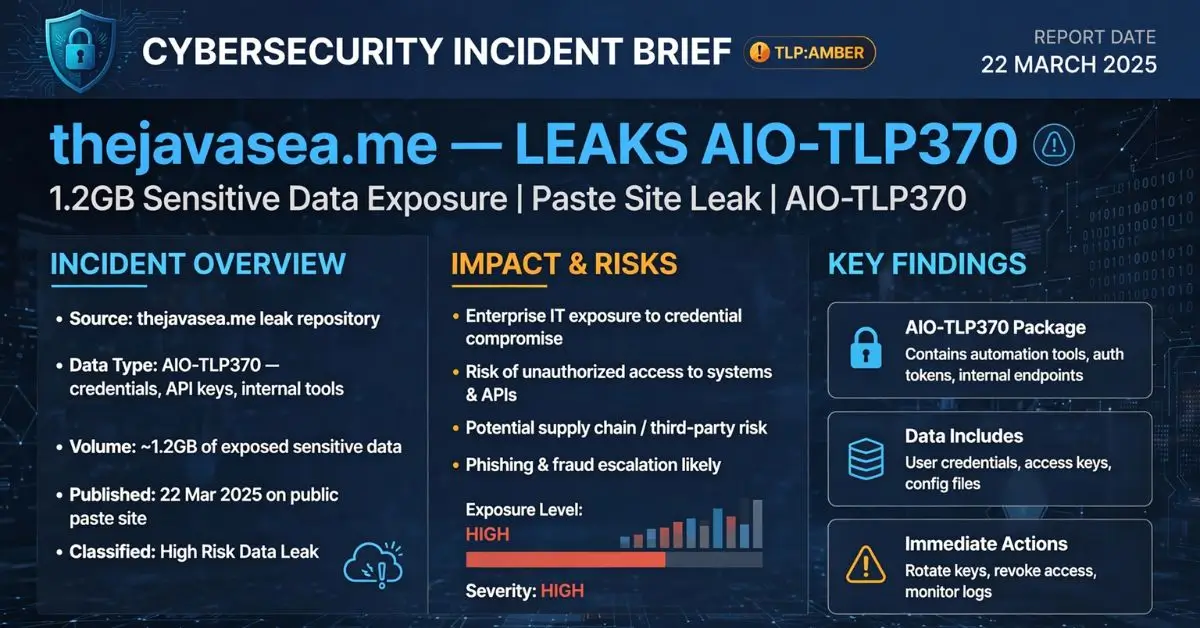
TheJavaSea.me Leaks AIO-TLP370: Full Breakdown, Risks, and Protection Steps
Data leaks happen more often than most people realize. But when a platform like TheJavaSea.me surfaces in connection with a tool called AIO-TLP370, the situation gets more serious. Personal credentials, login details, and potentially sensitive files become exposed to anyone who knows where to look.
This is not just a technical issue. It affects real people with real accounts, real passwords, and real financial information at risk.
What is thejavasea.me leaks aio-tlp370?
TheJavaSea.me is a platform known for hosting and distributing leaked data, cracked tools, and stolen digital content. AIO-TLP370 refers to an all-in-one tool connected to credential stuffing, data scraping, or account exploitation. When combined, thejavasea.me leaks aio-tlp370 refers to leaked data or tool files made publicly available through this platform, exposing users to identity theft and account compromise.
This article explains exactly what happened, who is at risk, and what steps you should take right now to protect yourself.
Quick Summary
TheJavaSea.me is a leak and data-sharing platform. AIO-TLP370 is a tool tied to data exploitation. Together, they represent a real cybersecurity concern. If your credentials appear in any associated leak, you need to change passwords, enable two-factor authentication, and monitor your accounts immediately.
What Is TheJavaSea.me
TheJavaSea.me operates as an underground platform where leaked databases, cracked software, and stolen digital assets get shared. Think of it as a marketplace for compromised data.
Unlike the dark web, which requires special browsers to access, platforms like TheJavaSea.me often sit on the open web. This makes them easier to find and easier for people with bad intentions to use.
The platform has gained attention because of the volume and variety of leaks it hosts. These include:
- Stolen email and password combinations
- Leaked software tools and exploit kits
- Scraped personal data from breached websites
- Cracked subscription service accounts
Platforms like this create a chain reaction. One breach on a company’s server feeds into tools that test those stolen credentials across hundreds of other websites. That is where AIO-TLP370 enters the picture.
What Is AIO-TLP370
AIO stands for “All-In-One.” In cybersecurity circles, AIO tools are multi-function programs designed to automate various tasks related to data exploitation.
TLP370 appears to be a specific version or variant identifier. While exact documentation on TLP370 is limited because these tools operate in underground spaces, the general function of AIO tools like this one includes:
Credential Stuffing: Taking leaked username and password pairs and automatically testing them across dozens of websites. If someone uses the same password for their email and their bank account, an AIO tool finds that match fast.
Account Checking: Verifying whether stolen accounts are still active and have value, such as paid subscriptions, stored payment methods, or linked services.
Data Scraping: Pulling personal information from exposed profiles, databases, or poorly secured websites.
Combo List Generation: Organizing stolen data into formatted lists that other attackers can use easily.
When thejavasea.me leaks aio-tlp370 content, it essentially makes these tools or their output freely available. That dramatically lowers the barrier for anyone who wants to misuse stolen data.
Why This Leak Matters More Than Most
Not every data leak carries the same weight. Here is why this particular situation deserves attention.
Scale of exposure. AIO tools work with massive databases. A single combo list can contain millions of email and password pairs. When these lists leak on a platform like TheJavaSea.me, the exposure multiplies overnight.
Ease of access. Because TheJavaSea.me operates on the open internet, you do not need technical skills or dark web access to find this content. A curious teenager with a search engine could stumble into it.
Cascading risk. The real danger is not just one compromised account. It is the domino effect. A leaked Netflix password leads to a compromised Gmail account, which leads to a breached bank login. AIO tools automate this exact chain.
Persistence. Once data appears on a platform like this, it stays circulating. Even if TheJavaSea.me removes a specific page, the files have already been downloaded and redistributed across forums, Telegram channels, and other sharing platforms.
Who Is at Risk
If you are wondering whether this affects you, here is a realistic breakdown.
| Risk Level | Who This Includes | Why They Are at Risk |
|---|---|---|
| High | Users who reuse passwords across multiple sites | Credential stuffing tools exploit this directly |
| High | People whose data appeared in past breaches | Their credentials may be in the combo lists linked to AIO-TLP370 |
| Moderate | Users with accounts on smaller, less secure websites | These sites are often the original source of leaked data |
| Lower | People using unique passwords and two-factor authentication | Much harder for automated tools to compromise |
A practical example: a US-based user who signed up for a small online forum in 2019 using the same email and password they use for Amazon. If that forum was breached and its data ended up in an AIO-TLP370 combo list on TheJavaSea.me, their Amazon account becomes a target.
How to Check If You Are Affected
You do not need to visit TheJavaSea.me to find out if your data was compromised. In fact, visiting leak platforms is risky in itself because they often contain malware.
Instead, use these trusted methods.
Have I Been Pwned (haveibeenpwned.com): Run by security researcher Troy Hunt, this free tool lets you enter your email address and see if it has appeared in known data breaches. It is the most trusted breach-checking resource available.
Google Password Checkup: If you use Google Chrome, the built-in password manager can flag saved passwords that appear in known leaks. Go to passwords.google.com and run a checkup.
Monitor financial accounts: Set up alerts on bank accounts and credit cards. Unusual activity is sometimes the first sign of compromised data.
Check email for unfamiliar login alerts: Many services send notifications when your account is accessed from a new device or location. Do not ignore these.
Immediate Steps to Protect Yourself
If you suspect your data is part of the leak connected to thejavasea.me leaks aio-tlp370, take these steps now.
1. Change passwords on critical accounts first.
Start with email, banking, and any account that stores payment information. Use strong, unique passwords for each one. A password like “T!m3rock$429” is far better than “password123.”
2. Enable two-factor authentication (2FA) everywhere possible.
This adds a second verification step, usually a code sent to your phone. Even if someone has your password, they cannot get in without this code. Prioritize email, financial services, and social media.
3. Stop reusing passwords immediately.
This is the single biggest vulnerability most people have. A password manager like Bitwarden (free) or 1Password (paid) generates and stores unique passwords for every site.
4. Review connected apps and services.
Many accounts allow third-party app access. Go through your Google, Facebook, and Microsoft accounts and revoke access for anything you do not recognize or no longer use.
5. Watch for phishing attempts.
After data leaks, phishing emails increase. Attackers use leaked information to craft convincing messages. If an email asks you to click a link or verify your account, go directly to the website instead of clicking the link.
The Bigger Picture: Why Platforms Like TheJavaSea.me Keep Appearing
Shutting down one leak platform does not solve the problem. When one site goes offline, another appears within weeks. The underlying issues are:
Massive amounts of stolen data already exist. Years of breaches across thousands of companies have created an enormous pool of compromised credentials. That data does not disappear.
Low barrier to entry. Tools like AIO-TLP370 make it easy for people with minimal technical skills to exploit leaked data. This is not advanced hacking. It is automated testing at scale.
Slow response from affected companies. Many breached companies take months to notify users, giving attackers a wide window to use the stolen data.
User behavior. Password reuse remains incredibly common. According to multiple studies, over 60% of internet users reuse passwords across multiple accounts. Until that changes, credential stuffing tools will remain effective.
What Law Enforcement Is Doing
Authorities in the US, UK, and Canada have increased efforts against data leak platforms. The FBI and Europol have taken down several high-profile forums and marketplaces in recent years.
However, enforcement faces real limitations. Many of these platforms operate through servers in countries with weak cybercrime laws. Operators use cryptocurrency and anonymity tools to stay hidden. Takedowns are often temporary because the data and tools get mirrored elsewhere.
The reality is that personal responsibility remains your best defense. Waiting for law enforcement or tech companies to fix this problem is not a reliable strategy.
Conclusion
The situation around thejavasea.me leaks aio-tlp370 is a clear reminder that online security is not optional. It is not something you set up once and forget about. Data leaks keep happening, tools keep evolving, and your personal information remains valuable to people who want to misuse it.
You do not need to become a cybersecurity expert to stay protected. Focus on the basics: unique passwords, two-factor authentication, and regular monitoring of your accounts. These three steps block the vast majority of automated attacks, including those powered by tools like AIO-TLP370.
Stay informed, stay cautious, and take the time to secure your digital life today.
Frequently Asked Questions
What is thejavasea.me leaks aio-tlp370?
It refers to leaked datasets and account-checking tools linked to TheJavaSea.me that can automate credential stuffing attacks.
Is it illegal to visit TheJavaSea.me?
Visiting a website is not always illegal, but downloading or distributing leaked data or hacking tools may violate the law and expose you to malware.
How can I check if my data was exposed?
Use trusted breach-monitoring services like Have I Been Pwned and change passwords if your accounts appear in a breach.
Can a VPN protect me from these leaks?
No. A VPN hides your IP address but cannot protect credentials that have already been stolen.
What is credential stuffing?
Credential stuffing is an automated attack that uses stolen usernames and passwords to access multiple accounts where passwords are reused.
Should I pay for identity theft protection?
It depends on your needs. Free steps like unique passwords, a password manager, 2FA, and credit monitoring provide strong protection, while paid services offer additional monitoring and convenience.