

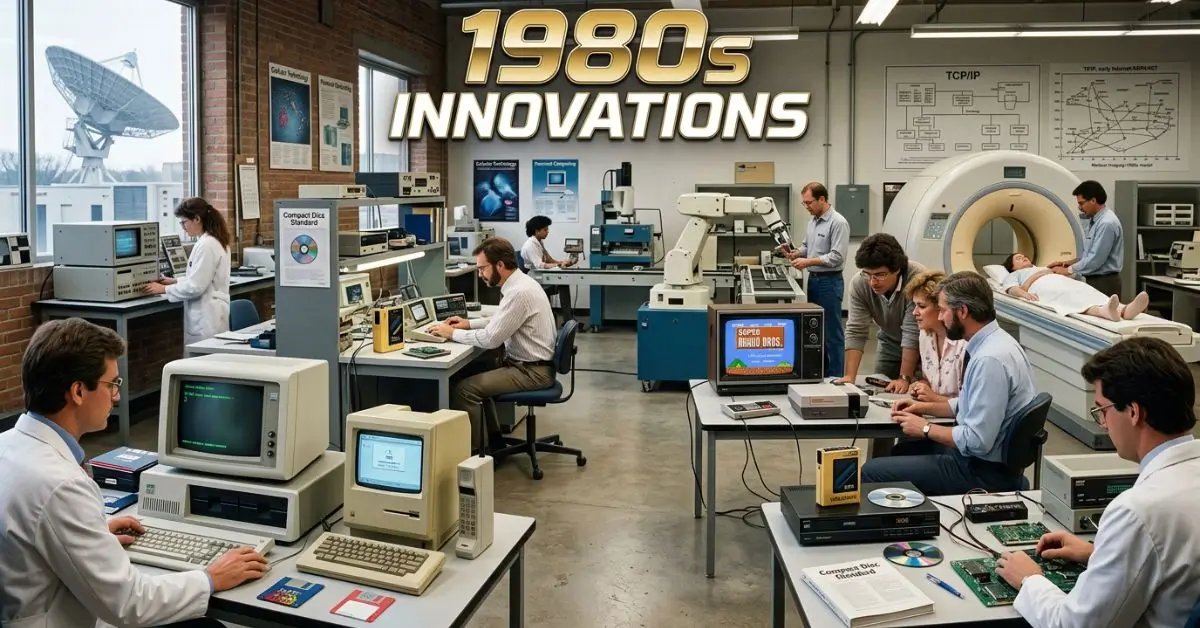
Introduction
Think about the device you’re reading this on right now. The smartphone. The laptop. The internet browser. None of it would exist without a single, remarkable decade — the 1980s.
Most people think of the 1980s as a time of neon fashion and pop music. But behind the scenes, engineers, scientists, and companies were quietly building the foundation of the digital world we live in today. The breakthroughs from that era didn’t just change technology — they changed everything.
What are 1980s innovations? They are the major scientific, digital, and engineering advances made between 1980 and 1989 — including the personal computer, early mobile networks, the World Wide Web’s groundwork, DNA fingerprinting, and more — that transformed how humans work, communicate, and live.
This article walks you through the most important tech innovations of the 1980s, explains why each one mattered, and shows you how their impact is still felt today.
Quick Summary
The 1980s gave us personal computers, the internet’s early infrastructure, mobile phones, GPS, and more. These weren’t just gadgets — they were turning points that built the modern digital world. If you work online, use a smartphone, or stream a video, you’re living inside the legacy of 1980s tech.
The Personal Computer Arrives in Every Home
Before the 1980s, computers were massive machines locked inside universities and corporations. Only specialists could use them. Then everything changed.
In 1981, IBM launched the IBM PC — a personal computer designed for regular people. Around the same time, Apple was pushing its own machines, and Microsoft was developing the software that would run on them. By the mid-1980s, home computing was real.
This wasn’t just a product launch. It was a complete shift in who technology was for. Suddenly, a small business owner in Chicago could manage accounts on a desktop. A student in London could write essays on a screen. A teacher in Toronto could build lesson plans using software.
The personal computer is one of the defining 1980s innovations because it took computing out of the lab and put it into people’s hands. Every laptop, tablet, and smartphone today is a direct descendant of those early machines.
The Internet Starts Taking Shape
Most people think the internet was invented in the 1990s. It wasn’t. The groundwork was laid firmly in the 1980s.
In 1983, ARPANET — the military and academic network that was the internet’s ancestor — switched to a new communication system called TCP/IP. This is the same protocol the modern internet still runs on today.
Then, in 1984, the Domain Name System (DNS) was introduced. That’s what allows you to type “google.com” instead of a string of numbers. Before DNS, connecting to another computer meant memorizing its numeric address.
By the end of the 1980s, Tim Berners-Lee at CERN in Switzerland was already sketching out the idea for the World Wide Web. He formally proposed it in 1989. The 1990s got the credit, but the 1980s did the heavy lifting.
These digital infrastructure milestones are easy to overlook because they happened behind the scenes — but without them, there is no internet.
Mobile Phones Go From Science Fiction to Reality
In 1983, Motorola released the DynaTAC 8000X — the world’s first commercially available handheld mobile phone. It weighed about 2.4 pounds, cost nearly $4,000, and could hold a charge for about 30 minutes of talk time.
It sounds laughable now. But at the time, it was revolutionary.
For the first time in history, you could make a phone call without being physically connected to a wire. The concept of personal, portable communication — something we now take completely for granted — was born in the 1980s.
The first cellular networks in the US (AMPS — Advanced Mobile Phone System) launched in 1983. By the end of the decade, mobile networks were spreading across the UK, Canada, and beyond.
Everything that came after — 3G, 4G, 5G, smartphones — grew from this foundation. The 1980s didn’t perfect mobile communication, but they started it.
The Compact Disc Transforms How We Consume Media
Before the CD, music lived on vinyl records and cassette tapes. Both wore down over time. Sound quality degraded. Tapes could snap.
In 1982, Sony and Philips launched the compact disc. It stored audio digitally, meaning the sound never deteriorated. You could play it a thousand times and it sounded exactly the same on the last play as it did on the first.
By the mid-1980s, CDs were outselling vinyl records in the US. By the late 1980s, they were the dominant music format worldwide.
More importantly, the CD introduced the general public to the idea of digital storage — data encoded as ones and zeros on a physical medium. That concept evolved directly into DVDs, Blu-rays, and eventually cloud storage and digital downloads.
The compact disc might seem old-fashioned today, but it was one of the most important 1980s innovations in consumer technology.
GPS Becomes a Working Reality
The Global Positioning System — GPS — was developed by the US Department of Defense throughout the late 1970s and 1980s. The first GPS satellite was launched in 1978, but the constellation became operational during the 1980s.
Initially, GPS was strictly for military use. Soldiers, ships, and aircraft could pinpoint their location anywhere on Earth. The precision was extraordinary compared to anything that existed before.
The civilian world got a preview of GPS potential in 1983 when, following the tragic shooting down of Korean Air Lines Flight 007 by the Soviet Union, President Reagan announced that GPS would eventually be made available for civilian aviation use.
Full civilian access came later, but the 1980s were when the system was built and proven. Today, GPS is in your car, your phone, your delivery apps, and your fitness tracker. It’s one of the most widely used technologies in the world, and it was born in this era.
The Space Shuttle Program Advances Computing and Materials Science
NASA’s Space Shuttle flew its first mission in 1981. But the Shuttle wasn’t just a space story — it was a technology story.
Building and operating the Shuttle required massive advances in computing, materials science, and engineering. Heat-resistant tiles, lightweight composite materials, real-time onboard computing systems — many of these were developed specifically for the program and later found their way into civilian applications.
Scratch-resistant lenses, memory foam, water filtration technology, and improved firefighting equipment all trace partial roots to NASA’s space program research of this era.
The Shuttle showed that computers could manage complex, high-stakes systems in real time — a principle that later became central to aviation, medical devices, and industrial automation.
DNA Fingerprinting Changes Crime, Medicine, and Identity
In 1984, British geneticist Alec Jeffreys at the University of Leicester discovered DNA fingerprinting — a method of identifying individuals through their unique genetic patterns.
The first real-world use came in 1986, when DNA evidence was used in a UK murder investigation. It changed law enforcement forever. For the first time, biological evidence could definitively identify or eliminate a suspect.
Beyond crime, DNA fingerprinting reshaped medicine, paternity testing, and the study of genetic diseases. It opened the door to the Human Genome Project, which launched in 1990.
While this is a biological innovation rather than a digital one, it belongs in any serious conversation about 1980s innovations because of its profound, lasting impact across multiple fields.
The Graphical User Interface Makes Computers Human-Friendly
Early computers required you to type commands. You had to know exact syntax. One wrong character and nothing worked. It was powerful but completely inaccessible to most people.
In 1984, Apple launched the Macintosh — a computer with a graphical user interface (GUI). Instead of typing commands, you clicked icons with a mouse. You saw folders, files, and windows on screen.
This was a game-changer. You didn’t need to be a programmer to use a computer anymore. The GUI made computing genuinely accessible to ordinary people.
Microsoft followed with Windows 1.0 in 1985. The concept evolved rapidly, and by 1989, visual computing was the new standard.
Every operating system you’ve ever used — Windows, macOS, iOS, Android — is built on the GUI concept that became mainstream in the 1980s.
A Quick Comparison: Key 1980s Tech Milestones
| Innovation | Year | Impact Area | Legacy Today |
|---|---|---|---|
| IBM PC | 1981 | Personal computing | All modern computers |
| TCP/IP Protocol | 1983 | Internet infrastructure | The entire internet |
| Motorola DynaTAC | 1983 | Mobile communication | Smartphones |
| Compact Disc | 1982 | Digital media storage | Cloud storage, streaming |
| GPS System | 1980s | Navigation & positioning | Phone maps, logistics |
| Apple Macintosh GUI | 1984 | User interface design | All modern OS interfaces |
| DNA Fingerprinting | 1984 | Biology & forensics | Modern medicine, law |
Why the 1980s Were Different From Any Other Decade
Many decades produce important inventions. But the 1980s were different because so many fundamental systems were being built at the same time — and they were all designed to connect.
The PC needed software (Microsoft). The software needed a user interface (Apple). The computers needed to talk to each other (TCP/IP). The network needed an address system (DNS). Mobile phones needed cellular networks (AMPS). All of this came together in one decade.
It wasn’t planned as a grand project. It happened because smart people were solving individual problems — and those solutions ended up building something much larger than anyone anticipated.
Conclusion
The 1980s didn’t just produce gadgets. They built the architecture of the modern world.
Every app you open, every search you run, every call you make on your phone — all of it traces back to decisions, inventions, and breakthroughs that happened between 1980 and 1989. The people who built these systems often didn’t know how far their work would reach. They were solving today’s problem, not designing tomorrow’s world.
That’s what makes the 1980s so remarkable. The impact wasn’t intentional — it was inevitable, because the ideas were that good.
Understanding where technology came from helps us appreciate where it’s going. The next wave of breakthroughs — in AI, quantum computing, and biotechnology — will likely look just as messy and disorganized in real time, but just as foundational in retrospect.
Frequently Asked Questions
What was the most important innovation of the 1980s?
The personal computer. It moved computing from institutions to everyday people, changing work, education, and communication forever. The IBM PC (1981) and Apple Macintosh (1984) defined this shift and shaped the direction of technology for the next four decades.
Did the internet exist in the 1980s?
Yes — in early form. ARPANET adopted TCP/IP in 1983, DNS launched in 1984, and the World Wide Web was proposed in 1989. It was mostly used by researchers and universities, but the core infrastructure the modern internet runs on was built right here in this decade.
How did 1980s technology affect everyday life in the US?
By 1989, millions of American homes had a personal computer. Mobile phones were entering business culture. CDs were replacing cassette tapes. Technology was becoming personal and portable for the first time — a clear shift from how life looked in 1979.
Were 1980s computers actually useful?
Absolutely. They handled word processing, spreadsheets, and databases well. The IBM PC launched with just 16KB of RAM, but software like Lotus 1-2-3 made it an essential business tool almost immediately.
What role did the UK and Canada play?
A significant one. Britain’s Tim Berners-Lee proposed the World Wide Web in 1989. Alec Jeffreys invented DNA fingerprinting in 1984. Canada was an early adopter of cellular networks. Innovation in this era was genuinely global — not just American.