

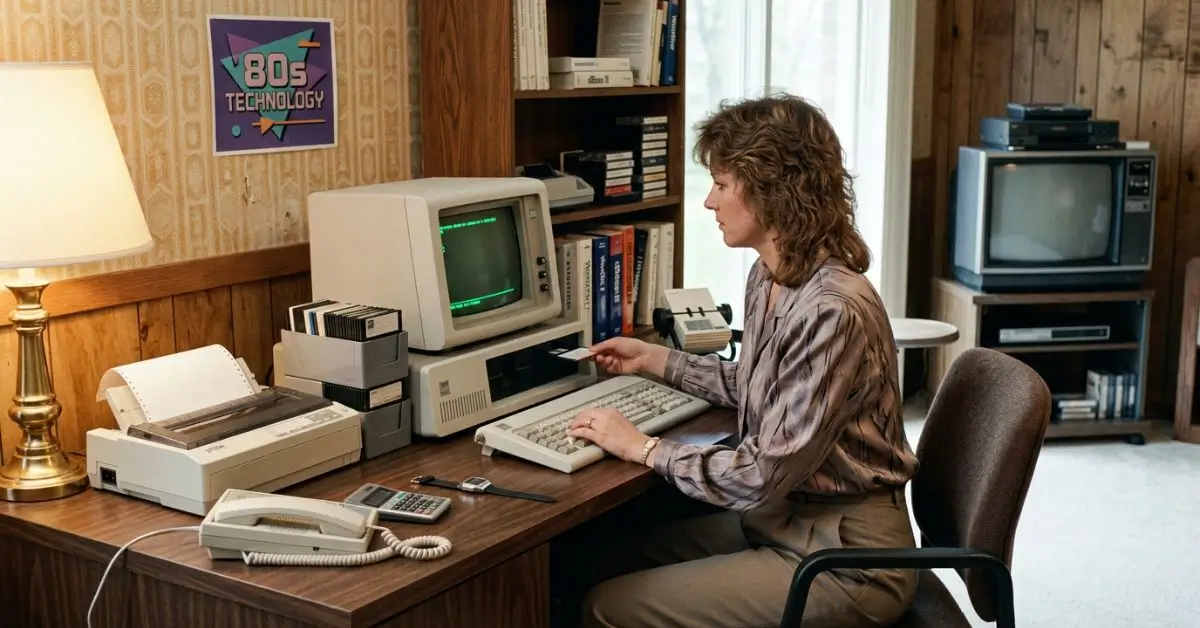
80s Technology
Most people alive today have never lived without a smartphone, the internet, or a personal computer. These things feel permanent like they’ve always existed.
They haven’t.
Every piece of modern technology you rely on daily has a starting point. And for most of it, that starting point is the 1980s. This was the decade when digital technology stopped being something only scientists and governments used and started becoming something ordinary people could access, own, and benefit from.
What is 80s technology? It refers to the wide range of electronic, digital, and scientific inventions developed and commercialized between 1980 and 1989. This includes personal computers, mobile phones, early internet infrastructure, compact discs, video game consoles, and more innovations that collectively launched the modern digital era.
This article covers the most important examples of 80s technology, explains what made each one significant, and connects them to the world we live in right now.
Quick Summary
The 1980s produced the personal computer, mobile phones, the internet’s core infrastructure, CDs, GPS, and the graphical user interface. These weren’t isolated inventions they built on each other and together created the foundation of modern digital life. If you use a phone, laptop, or the internet today, you’re using the legacy of 80s tech.
Personal Computers: From Labs to Living Rooms
Before the 1980s, computers were institutional. They lived in universities, government agencies, and large corporations. They filled entire rooms and required trained operators.
That changed fast.
In 1981, IBM released its Personal Computer — the IBM PC. It was designed to sit on a desk and be used by one person. No specialist required. Around the same time, Apple was developing its own machines, and Microsoft was building the operating software that would power millions of them.
By the mid-1980s, home computing was real and growing quickly. A small business owner in Dallas could now manage finances on a desktop machine. A high school student in Toronto could type essays and run basic programs. A teacher in Birmingham could build lesson materials using software.
This was one of the most important shifts in the history of 80s technology not just because of the machines themselves, but because of what they represented. Computing became personal. It became accessible. And that changed everything that came after.
The Internet’s Invisible Foundation
The internet as most people know it — websites, social media, video streaming — arrived in the 1990s. But the essential infrastructure was built in the 1980s, mostly out of public view.
In 1983, ARPANET — the academic and military network that preceded the internet — switched to TCP/IP. This is the communication protocol the modern internet still runs on today. Every time you load a webpage, send an email, or stream a video, TCP/IP is doing the work behind the scenes.
In 1984, the Domain Name System (DNS) was introduced. This is the system that lets you type “youtube.com” instead of a long string of numbers. Without DNS, the internet would be practically unusable for ordinary people.
Then, in 1989, British scientist Tim Berners-Lee proposed the World Wide Web while working at CERN in Switzerland. He formally submitted his idea in a document that described how information could be linked and shared across a global network. The Web went live in 1991 — but the thinking happened in the 80s.
The internet didn’t appear from nowhere. It was built, piece by piece, during this decade.
Mobile Phones: The First Step Toward the Smartphone
In 1983, Motorola released the DynaTAC 8000X — the world’s first commercially available handheld mobile phone. It weighed nearly 2.5 pounds, cost close to $4,000, and offered around 30 minutes of battery life for calls.
By today’s standards, that sounds almost comical.
But at the time, it was extraordinary. For the first time in history, a person could make a phone call without any physical connection to a wire or a wall. The concept of personal, portable communication — something billions of people now take for granted — was introduced to the world through this device.
The first cellular networks in the US launched in 1983 under the AMPS system (Advanced Mobile Phone System). By the late 1980s, mobile networks were expanding across the UK, Canada, and much of the developed world.
The DynaTAC wasn’t a smartphone. But it was the first step on the path that leads directly to the device in your pocket right now.
The Compact Disc and the Shift to Digital Media
Before the CD, music lived on vinyl records and magnetic cassette tapes. Both had real limitations — tapes wore down, records scratched, and sound quality degraded with every play.
In 1982, Sony and Philips introduced the compact disc. Music was now stored digitally — as ones and zeros — which meant it didn’t degrade. Play it once or play it a thousand times, it sounds exactly the same.
By 1986, CDs were outselling vinyl in the US. By the end of the decade, they were the dominant music format worldwide.
But the CD’s significance goes beyond music. It introduced the general public to the idea of digital storage — the concept that information could be encoded on a physical medium without any loss of quality over time. That idea evolved directly into DVDs, Blu-rays, USB drives, and eventually cloud storage and digital downloads.
The compact disc was a quiet revolution in how people thought about data.
Video Games Go Mainstream
Gaming existed before the 1980s, but it became a true cultural force during this decade.
In 1980, Pac-Man hit arcades in the US and became a phenomenon. In 1985, Nintendo released the Nintendo Entertainment System (NES) in North America, reviving a home gaming market that had nearly collapsed after the crash of 1983. The NES sold over 60 million units worldwide.
Games like Super Mario Bros., The Legend of Zelda, and Tetris weren’t just entertainment — they demonstrated that software could create immersive, interactive experiences for mass audiences. That idea is now the foundation of a global gaming industry worth hundreds of billions of dollars.
The 80s gaming revolution also pushed forward advances in graphics processing, sound chips, and user interface design — technical progress that fed directly into broader computing development.
The Graphical User Interface: Making Computers Human
Early computers required typed commands. You had to know exact syntax — one wrong character and nothing worked. This made computers powerful but completely inaccessible to most people.
In 1984, Apple launched the Macintosh — a computer built around a graphical user interface (GUI). Instead of typing, you pointed and clicked with a mouse. You saw folders on a screen that looked like a real desktop. Icons represented files and programs visually.
This was a fundamental shift in 80s technology. You no longer needed to know how to program to use a computer. The GUI made computing genuinely accessible to people who had no technical background.
Microsoft released Windows 1.0 in 1985, following Apple’s lead. By 1989, visual computing was the new standard — and it has remained so ever since.
Every operating system you have ever used — Windows, macOS, iOS, Android — is built on the GUI concept that went mainstream in the 1980s.
GPS: Built in the 80s, Used by Everyone Now
The Global Positioning System was developed by the US Department of Defense across the late 1970s and throughout the 1980s. The satellite constellation became operational during this decade, initially for military use only.
GPS allowed military assets — aircraft, ships, ground forces — to determine their precise location anywhere on Earth. The accuracy was unlike anything that had existed before.
Following the 1983 tragedy of Korean Air Lines Flight 007, President Reagan announced that GPS would eventually be made available for civilian use. Full civilian access came later, but the system itself was built and proven in the 1980s.
Today, GPS is embedded in smartphones, car navigation systems, delivery tracking, emergency services, agriculture, and aviation. It is one of the most widely used technologies on the planet — and it was born in this era.
A Quick Look: Key 80s Technology at a Glance
| Technology | Year Introduced | Why It Mattered | Still Relevant Today |
|---|---|---|---|
| IBM Personal Computer | 1981 | Made computing personal | Foundation of all modern computers |
| TCP/IP Protocol | 1983 | Built the internet’s backbone | Powers the entire internet |
| Motorola DynaTAC | 1983 | First handheld mobile phone | Direct ancestor of smartphones |
| Compact Disc | 1982 | Introduced digital media storage | Led to streaming and cloud storage |
| Apple Macintosh GUI | 1984 | Made computers user-friendly | All modern OS interfaces |
| Nintendo NES | 1985 | Mainstreamed home gaming | Billion-dollar gaming industry |
| GPS System | 1980s | Precision global navigation | In every smartphone today |
Why This Decade Was Different
Many decades produce important inventions. But the 1980s had something unusual — multiple foundational technologies arriving and connecting simultaneously.
The personal computer needed software. The software needed a better interface. The computers needed to talk to each other. The network needed an address system. Mobile phones needed cellular infrastructure. And all of this happened within roughly ten years.
None of it was part of a single master plan. Engineers and companies were solving individual problems. But the solutions fit together in a way that built something much larger — the digital world as we know it.
That’s the real legacy of 80s technology. Not any single invention, but the way they combined.
Conclusion
It’s easy to look back at 80s technology and see chunky computers, oversized phones, and slow networks. The hardware looks outdated. The speeds seem laughably slow.
But focus on what those technologies did — not what they looked like — and the picture changes completely.
They put computing power in people’s hands. They connected computers across continents. They made digital media a reality. They gave everyone a portable phone. They made interfaces that ordinary people could actually use.
Every piece of modern technology you depend on today was either invented in the 1980s or built directly on something that was. That’s not nostalgia — that’s just history.
Frequently Asked Questions
What is considered 80s technology?
Electronic and digital inventions developed between 1980 and 1989 — including personal computers, mobile phones, compact discs, early internet infrastructure, GPS, the graphical user interface, and home video game consoles. Together, these innovations launched the modern digital era we still live in today.
What was the most important tech invention of the 1980s?
The personal computer. It moved computing from institutions to everyday people, reshaping work, education, and communication. The IBM PC (1981) and Apple Macintosh (1984) defined this shift and directly enabled the software industry, internet economy, and eventually the smartphone.
Did the internet exist in the 1980s?
Yes — in early form. ARPANET adopted TCP/IP in 1983, DNS launched in 1984, and Tim Berners-Lee proposed the World Wide Web in 1989. It was used mainly by researchers, but the core infrastructure powering today’s internet was built right here in this decade.
How did 80s technology change everyday life in the US?
By 1989, millions of American homes had a personal computer, mobile phones were entering business culture, and CDs had replaced cassette tapes. Life looked noticeably different from 1979 — technology was becoming personal, portable, and digital for the first time.
Are any 1980s technologies still used today?
Many of them. TCP/IP still runs the internet. 1980s GPS satellites remain part of the active constellation. The graphical user interface is the basis of every modern OS. The 80s didn’t just influence modern technology — it fundamentally built it.