

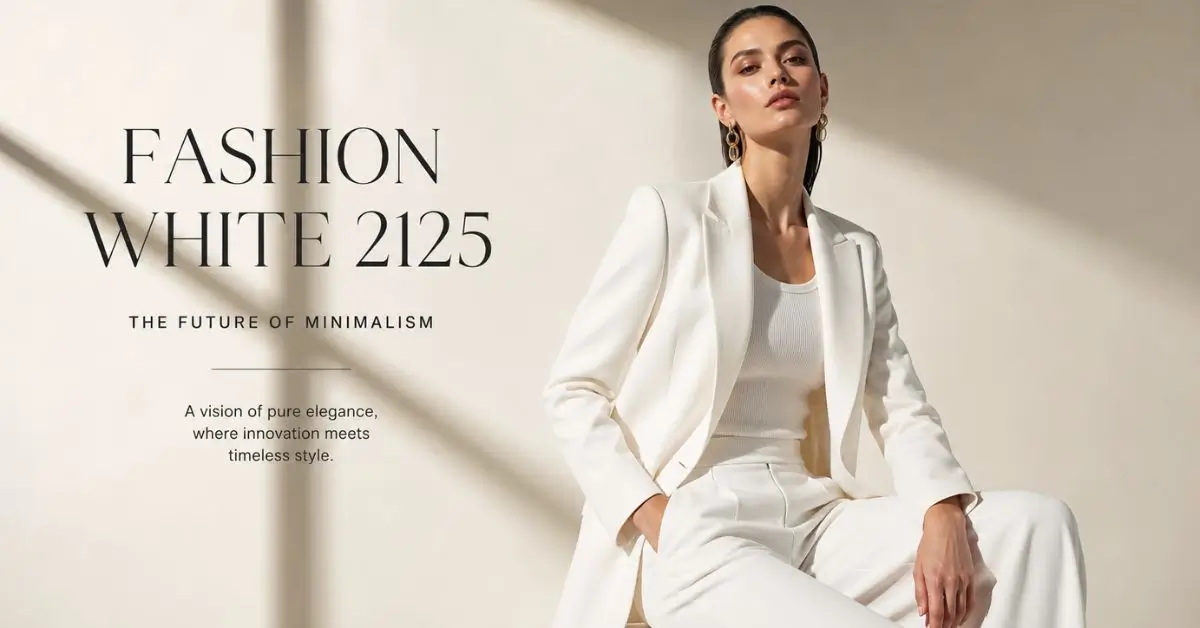
Fashion White 2125: Imagining the Future of Style, Clothing, and Self-Expression
Fashion has always been one of the clearest mirrors humanity holds up to itself. What people wear in any given era tells you everything about their values, fears, ambitions, technologies, and social structures. The clothing of ancient Rome spoke of status and empire. The fashion of the 1920s reflected liberation and economic optimism. The streetwear of the early 2000s told a story of cultural collision and digital identity formation.
So what will fashion in 2125 say about the people wearing it?
That question is genuinely fascinating and more meaningful than it might first appear. The trends, technologies, and values taking root in fashion right now are the seeds of what clothing will become a century from now. Understanding those connections gives us real insight into where style is heading, not just wild guessing.
Fashion white 2125 as a concept captures something specific about future fashion aesthetics: the idea of clean, pure, technologically integrated clothing that reflects a society that has moved beyond excess toward intentional, meaningful design. White, across cultures and across time, has carried associations with clarity, purity, innovation, and new beginnings. In the context of future fashion, it becomes a canvas for everything that comes next.
Fashion white 2125 refers to a forward-looking fashion concept imagining what clothing, style, and personal expression will look like by the year 2125. It combines speculation grounded in current fashion technology trends, sustainability movements, and cultural shifts to envision a future where garments are intelligent, sustainable, culturally rich, and deeply personal. The aesthetic often centers on clean lines, adaptive materials, and purposeful design that reflects a more technologically advanced and environmentally conscious society.
This guide explores every dimension of what fashion in 2125 might realistically involve.
Quick Summary
Fashion white 2125 is a creative concept exploring what clothing and style could become a century from now. Grounded in current trends in smart textiles, sustainable materials, digital identity, and cultural fusion, this guide covers future fashion aesthetics, technology integration, sustainability, personal expression, and how today’s innovations point toward tomorrow’s wardrobe.
Why Thinking About Future Fashion Matters Today
Thinking seriously about fashion a century ahead is not just an intellectual exercise. It shapes decisions being made in design studios, research labs, and business boardrooms right now.
The materials scientists developing lab-grown leather today are working toward the fashion of 2050. The designers experimenting with bioluminescent fabrics are laying groundwork for what will be mainstream in 2125. The sustainability advocates pushing for circular fashion systems are building the infrastructure that future generations will inherit.
Understanding where fashion is going helps consumers make better choices now about what they buy and support. It helps designers understand which creative directions have long-term significance. And it gives everyone a richer appreciation for what clothing actually is: not just protection from the elements, but one of humanity’s most powerful forms of communication.
Fashion white 2125 sits at the intersection of all these ideas. It is about envisioning the endpoint of trends already in motion and asking what human beings will be saying about themselves through what they wear when the tools available to them are unimaginably more sophisticated than today’s.
The Aesthetic of Future Fashion: What Will It Look Like?
The visual language of fashion in 2125 will likely look dramatically different from today, but the shift will not be random. It will follow the logic of where current aesthetic movements are heading.
The Dominance of Clean, Intentional Design
The maximalist trend that peaked in the early 2020s is already giving way to a more intentional minimalism. This is not the cold, empty minimalism of the early 2010s. It is a warm, purposeful simplicity that values quality over quantity, meaning over decoration.
By 2125, this trajectory suggests fashion defined by fewer, better things. Garments with purpose built into every design choice. No excess fabric, no unnecessary ornamentation, no decoration that does not carry meaning. The white aesthetic of future fashion captures this spirit precisely. Clean, clear, and carrying enormous possibility in its simplicity.
This does not mean everyone will dress identically. Individuality will matter just as much in 2125 as it does today, perhaps more. But individuality will be expressed through personalization and customization rather than through consuming mass-produced variety.
Bioluminescence and Living Materials
One of the most genuinely exciting areas of current material science is the development of biological textiles. Researchers are already experimenting with fabrics grown from mycelium, the root structure of mushrooms, that can be shaped and textured like leather without any animal involvement.
By 2125, this technology will have advanced dramatically. Fashion white in the future context might literally mean garments that glow softly with bioluminescent properties, textiles grown from living organisms that are fully biodegradable, or fabrics that change texture and structure in response to environmental conditions.
The whiteness of future fashion in this context is not painted or dyed. It emerges from the inherent properties of the materials themselves.
Shape-Shifting and Adaptive Clothing
Smart textiles are already in development that can change shape, tension, and thermal properties in response to body temperature and movement. By 2125, adaptive clothing will be so sophisticated that a single garment could functionally serve the purpose of multiple items depending on how it is configured.
Imagine a white garment that starts the day as a structured jacket, adjusts to a lighter configuration as the afternoon warms, and transitions to formal evening wear through subtle structural reconfiguration. The garment remains the same object. Its expression changes in response to context and need.
This adaptive quality fundamentally changes the relationship between a person and their wardrobe. Instead of owning many items for different occasions, you own fewer items with deeper capabilities.
Technology Integration: Fashion Becomes Functional Intelligence
The technology embedded in clothing will be one of the defining characteristics of fashion in 2125. But the integration will be invisible rather than visible. The failure mode of early wearable technology was making the technology the aesthetic statement. Future fashion will make the technology disappear into the garment completely.
Health and Biometric Integration
Clothing in 2125 will almost certainly monitor health metrics continuously, far beyond what today’s smartwatches can do. Fabric integrated with biosensors will track cardiovascular health, hydration, stress markers, sleep quality, and dozens of other biometric indicators without any visible technology component.
The garment looks like fabric. It functions like a comprehensive health monitoring system. The data it collects belongs to the wearer and informs both personal health decisions and interactions with healthcare systems.
Climate Adaptation
Climate in 2125 will be significantly different from today due to the effects of climate change that are already locked in by current emissions levels. Fashion will adapt to these realities by prioritizing thermal regulation in ways that current clothing only approximates.
Smart textiles that actively manage body temperature, block specific radiation frequencies, or provide UV protection will be standard rather than experimental. Fashion white in this context carries functional significance beyond aesthetics. Light-colored, reflective garments that manage heat in a warmer world are a practical response to environmental reality as much as an aesthetic choice.
Digital Identity and Augmented Reality Fashion
By 2125, the boundary between physical and digital fashion will have dissolved in ways difficult to fully imagine from today’s perspective. Augmented reality overlays that allow garments to display dynamic patterns, change apparent color, or carry personalized information visible only through specific viewing technologies will likely be standard.
Your white garment might appear different to different people depending on the AR filters and digital overlays you have configured. Fashion becomes not just physical self-expression but digital self-expression layered on top of physical reality.
Sustainability: The Non-Negotiable Foundation
Any honest vision of fashion in 2125 must center sustainability as a foundational reality rather than an optional feature. The fast fashion model of 2025 is environmentally unsustainable and is already under significant pressure from both regulatory bodies and consumer behavior shifts.
By 2125, the fashion industry will have undergone a complete structural transformation in how garments are produced, used, and returned to the material cycle.
Circular Fashion at Scale
Circular fashion means nothing goes to waste. Materials from garments at the end of their life are fully recovered and reintegrated into new production. This system requires both technological capability and regulatory frameworks that are only beginning to develop today.
By 2125, circular fashion will be the default rather than the exception. The concept of textile waste will be as foreign as the concept of throwing away a battery is beginning to feel in 2025.
Local and Regional Production
Global supply chains for fashion, which currently stretch across dozens of countries and generate enormous carbon footprints in transportation alone, will likely give way to more localized production systems enabled by advanced manufacturing technologies.
3D printing of garments from locally produced biomaterials, combined with on-demand production that eliminates overstock waste, represents a radically different manufacturing model. Fashion white 2125 in this context reflects garments produced close to their wearers, from materials grown or synthesized locally, with minimal transportation impact.
The Rental and Sharing Economy for Clothing
Ownership as the primary relationship between people and clothing will likely shift significantly by 2125. Subscription-based access to high-quality, adaptive garments that circulate through a community rather than being individually owned represents both a more sustainable and potentially more economically accessible model.
This system works particularly well for occasion-specific garments. Why own a formal gown worn twice when you can access one made from superior materials for a specific event and have it returned to circulation afterward?
Cultural Fusion and Identity in 2125 Fashion
Fashion does not exist in isolation from culture, and culture in 2125 will reflect a century of continued globalization, migration, climate displacement, and digital connection across borders.
The fashion of 2125 will draw from a richer and more consciously honored range of cultural traditions than today’s fashion industry manages. Indigenous textile traditions, craft practices from every region of the world, and cultural aesthetic vocabularies that current global fashion largely ignores will all contribute meaningfully to the visual language of future clothing.
This is not the cultural appropriation that has been a persistent problem in contemporary fashion. It is genuine cultural exchange and honoring of heritage in a world where those conversations have had a century to mature.
The white aesthetic of future fashion in this cultural context represents not emptiness but possibility. A canvas on which the full richness of human cultural expression can be layered, mixed, and made personal.
Fashion White 2125: A Summary Comparison
| Fashion Dimension | Fashion Today (2025) | Fashion White 2125 (Projected) |
|---|---|---|
| Primary Material | Cotton, synthetic fibers | Biomaterials, lab-grown textiles |
| Technology | Early wearables, smart fabrics | Fully integrated invisible tech |
| Production Model | Global supply chains, mass production | Local, circular, on-demand |
| Sustainability | Growing movement, not yet standard | Foundational, non-negotiable |
| Personalization | Mass market with some customization | Deep personalization, adaptive garments |
| Cultural Influence | Global but often appropriative | Genuinely diverse, honoring heritage |
| Garment Lifespan | 2–5 years average | Decades, with material recovery |
| Digital Dimension | Social media presentation | AR integration, digital fashion layers |
Frequently Asked Questions
What is fashion white 2125?
Fashion white 2125 is a creative concept exploring how fashion, clothing, and personal style might evolve by the year 2125. It combines current trends in sustainable materials, smart textiles, digital identity, and cultural fusion to envision a future where garments are intentional, adaptive, technologically integrated, and environmentally responsible. The white aesthetic represents clarity, innovation, and the clean canvas of future possibility.
What will clothes look like in 2125?
Clothes in 2125 will likely be simpler in visible design but far more sophisticated in function. Smart textiles that adapt to temperature, monitor health, and integrate with digital systems will be standard. Materials will be grown from biological sources rather than manufactured from petrochemicals. Garments will last decades rather than seasons and will be fully recyclable at the end of their life.
How will technology change fashion by 2125?
Technology will fundamentally transform fashion by making intelligent functionality invisible within garments. Health monitoring, climate adaptation, digital identity expression through augmented reality, and adaptive structural reconfiguration will all be standard features of everyday clothing. The technology will disappear into the fabric rather than being visible as separate components, creating garments that look simple but function with sophisticated intelligence.
Will sustainable fashion be standard by 2125?
Yes, sustainable fashion will almost certainly be the baseline standard by 2125 rather than a niche premium option. Regulatory pressure, consumer behavior shifts, and technological advances in material science and manufacturing will have transformed the industry’s relationship with environmental impact. Circular production systems, biological materials, and local manufacturing will replace the global fast fashion model that dominated the early 21st century.
How will cultural diversity influence fashion in 2125?
By 2125, fashion will draw more genuinely and respectfully from the full diversity of global cultural traditions than today’s industry manages. A century of ongoing conversations about cultural appropriation, combined with greater global connection and cultural exchange, will produce a fashion landscape that honors diverse textile traditions, craft practices, and aesthetic vocabularies from every region of the world in more authentic ways.
What role will digital fashion play by 2125?
Digital fashion will be deeply integrated with physical fashion by 2125. Augmented reality overlays will allow garments to display dynamic patterns, change apparent appearance, or carry personalized digital information. The boundary between what you physically wear and how it appears in digitally mediated environments will be fluid and highly personalized, creating a new dimension of self-expression that does not exist in today’s fashion system.
Will people still value individual style in 2125?
Yes, individual style and personal expression through clothing will remain deeply important in 2125. Human beings use clothing as a fundamental form of communication about identity, belonging, and individuality. Technology and sustainability will change the tools available for self-expression through fashion, but the fundamental human desire to use clothing as a personal statement will persist. Future fashion will likely enable more personalized expression, not less.