

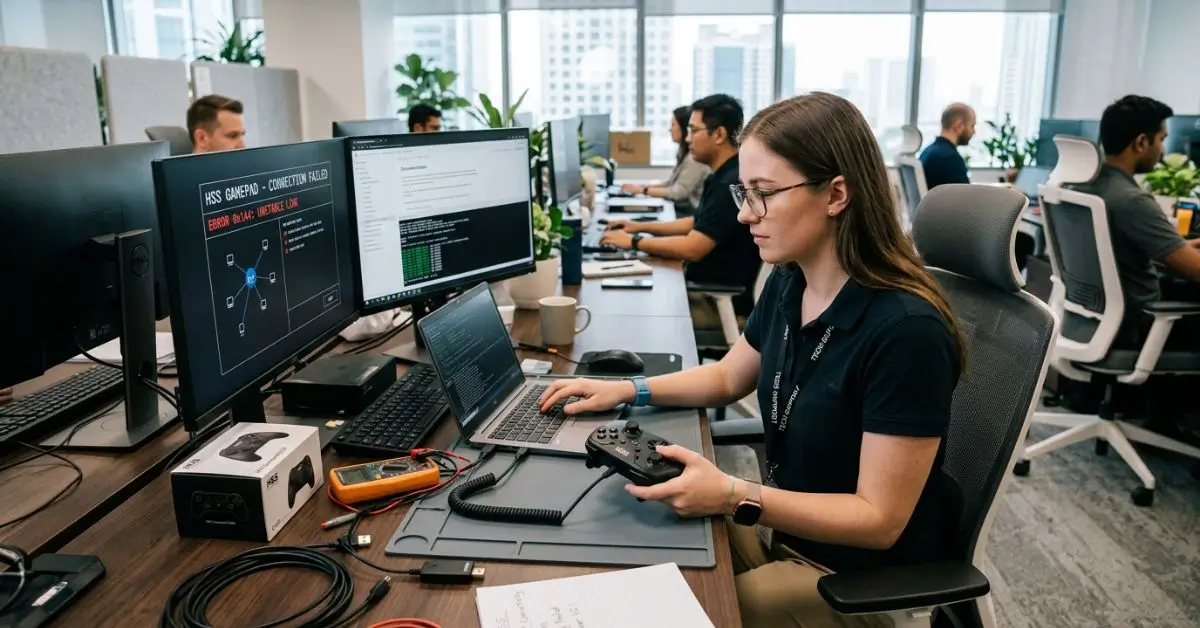
Connectivity Issues Hssgamepad
You sit down to play, plug in your HSS gamepad, and nothing happens. Or maybe it connects, works for five minutes, then drops out randomly. Or the Bluetooth pairs but the inputs do not register properly in your game.
Connectivity issues with a gamepad are frustrating precisely because they stop you from doing what you actually want to do. And the problem is rarely obvious at first. A dozen different things can cause a gamepad to fail to connect or disconnect unexpectedly, from a faulty cable to a driver conflict to a simple Bluetooth interference problem.
This guide walks through every major cause of connectivity issues with the HSS gamepad, organized by connection type, with clear steps to diagnose and fix each one. By the end, you will know exactly what to check, in what order, and what to do when basic fixes do not work.
Connectivity issues with the HSS gamepad refer to any situation where the controller fails to connect, disconnects unexpectedly, shows input lag, or is not recognized by the host device. These problems can occur across wired USB, Bluetooth, and 2.4GHz wireless connections and are caused by a range of factors including hardware faults, driver conflicts, software settings, battery issues, and wireless interference.
Quick Summary
connectivity issues hssgamepad issues usually come down to one of five causes: a faulty cable or port, outdated or missing drivers, Bluetooth interference, low battery, or software settings blocking the device. This guide covers all of them with specific fixes for wired, Bluetooth, and wireless dongle connections. Start with the quick checks and work through systematically.
Start Here: Quick Checks Before Anything Else
Before diving into detailed troubleshooting, run through these basic checks. They resolve a surprising number of connectivity problems in under two minutes.
Try a different USB port
If you are using a wired connection and the gamepad is not recognized, plug it into a different USB port on your PC or device. Faulty or underpowered USB ports are one of the most common and most overlooked causes of connection failure. USB ports on the back of a desktop PC are typically more reliable than front panel ports.
Try a different cable
If the gamepad still does not connect after switching ports, try a different USB cable of the same connector type. Cables fail more often than most people expect. A cable that looks fine externally can have an internal break that causes intermittent or total connection failure. This is especially common with heavily used cables that get bent repeatedly near the connector ends.
Check the battery level
For wireless models, low battery is one of the most common causes of unstable connections and unexpected disconnections. Charge the gamepad fully before troubleshooting any wireless connectivity issue. Some models also have an indicator light that changes color or blinks to signal low battery.
Restart your device
A full restart of your PC, console, or smartphone clears temporary software states that can interfere with device detection. This takes two minutes and often resolves recognition issues that have no other obvious cause.
Wired USB Connectivity Issues: Causes and Fixes
If your HSS gamepad uses a wired USB or USB-C connection and is not being recognized or keeps disconnecting, here is a systematic approach to finding and fixing the problem.
Device not recognized at all
When you plug in the gamepad and nothing happens, open Device Manager on Windows by right-clicking the Start button and selecting Device Manager. Look for any entry under Human Interface Devices or Universal Serial Bus controllers with a yellow warning triangle. That triangle indicates a driver or recognition error.
If you see the gamepad listed with an error, right-click it and select Uninstall Device. Disconnect the gamepad, wait ten seconds, and reconnect. Windows will attempt a fresh driver installation. For most HSS gamepad models, Windows 10 and 11 include generic HID drivers that work for basic functionality without needing a separate download.
If no driver installs automatically, visit the HSS gamepad manufacturer’s website and download the specific driver for your model. Install it with the gamepad disconnected, restart your PC, then connect the gamepad.
Gamepad recognized but not working in games
If the device appears in Device Manager without errors but does not work in your game, the issue is usually within the game’s input settings rather than the connection itself. Open the game’s settings and look for a controller or input section. Many PC games default to keyboard and mouse input and require you to manually enable gamepad support or select the connected controller.
Also check whether the game uses DirectInput or XInput. Some older games use DirectInput, which may require a compatibility mode or a third-party tool like x360ce to remap the HSSgamepad’s input to a recognized format.
Intermittent disconnections on wired connection
If the gamepad connects but drops out during use, the cable is the most likely culprit. Try the cable replacement step first. If a new cable resolves it, the original cable had a physical fault.
If the disconnections continue with a new cable, check your USB power management settings. Windows sometimes powers down USB ports to save energy, which can interrupt a connected gamepad. Go to Device Manager, expand USB Root Hub entries, right-click each one, select Properties, go to the Power Management tab, and uncheck Allow the computer to turn off this device to save power. Apply this setting to all USB root hubs.
Bluetooth Connectivity Issues: Causes and Fixes
Bluetooth connectivity issues with the HSS gamepad are some of the most commonly reported problems. Bluetooth is a more complex connection method than wired USB and has more potential points of failure.
Gamepad not appearing in Bluetooth scan
If the gamepad does not show up when you scan for Bluetooth devices, confirm it is in pairing mode. Most HSS wireless gamepads enter pairing mode by holding a dedicated Bluetooth button or a button combination for three to five seconds until an indicator light flashes rapidly. Consult your specific model’s manual if you are unsure of the pairing method.
Also confirm that Bluetooth is enabled on your PC or device and that it is not in a disabled or airplane mode state. On Windows, open Settings, go to Devices or Bluetooth and devices, and verify Bluetooth is toggled on.
Gamepad pairs but disconnects immediately
This typically happens when the gamepad is attempting to reconnect to a previously paired device while you are trying to pair it to a new one. Clear the gamepad from your device’s Bluetooth list and remove all previous pairings from the gamepad itself if your model has a reset function. Then re-pair from scratch.
On Windows, go to Bluetooth settings, find the HSS gamepad in the paired devices list, click Remove device, and then re-pair the gamepad fresh.
Bluetooth connection drops during gameplay
Wireless interference is the primary cause of Bluetooth drops during use. Common sources of interference include other Bluetooth devices in the same room, nearby Wi-Fi routers operating on the 2.4GHz band, microwave ovens, and cordless phones.
Try moving closer to your PC or device. Turn off other Bluetooth devices in the room temporarily and test whether the connection stabilizes. If your PC has both a 2.4GHz and 5GHz Wi-Fi option, switch to 5GHz to reduce interference with Bluetooth.
Also check the distance between the gamepad and your device. Most Bluetooth gamepads have an effective range of around 30 feet in open space. Walls, furniture, and other objects reduce this range significantly.
High latency on Bluetooth connection
If the gamepad connects but inputs feel delayed, your Bluetooth adapter may not support the low-latency profiles that modern gamepads use. Check whether your PC’s Bluetooth adapter supports Bluetooth 5.0 or higher. Older Bluetooth 4.0 adapters can work but may produce higher latency with newer devices.
If your built-in Bluetooth adapter is outdated, a USB Bluetooth 5.0 adapter costs between $10 and $30 and often resolves latency issues that the internal adapter cannot solve.
2.4GHz Wireless Dongle Issues: Causes and Fixes
If your HSS gamepad uses a 2.4GHz USB dongle for wireless connection, the troubleshooting steps differ slightly from Bluetooth.
Gamepad not connecting to the dongle
First, ensure the dongle is fully seated in the USB port. Remove and reinsert it. Try a different USB port. Some USB hubs do not provide enough power or bandwidth for wireless dongles. Plug the dongle directly into a port on the PC itself rather than through a hub.
If the gamepad still does not connect to the dongle, perform a re-sync. The exact method varies by model, but typically involves pressing a sync button on the dongle and a sync button on the gamepad simultaneously until the indicator lights confirm pairing.
Dongle recognized but connection unstable
Interference from other 2.4GHz devices affects dongle connections just as it does Bluetooth. Wi-Fi routers, other wireless peripherals, and nearby electronics all operate in the 2.4GHz range. Moving the dongle closer to the gamepad using a USB extension cable can improve signal strength and stability significantly. A short USB extension that positions the dongle on the desk rather than behind the PC tower often resolves intermittent dongle connection problems entirely.
Software and Game-Level Issues
Sometimes the HSS gamepad hardware and connection are both working correctly, but software issues prevent the controller from functioning properly.
Conflicting input software
If you have other controller software installed, such as DS4Windows, Steam Input, or third-party mapping tools, these can conflict with HSS gamepad detection. Disable or close any running controller software and test the gamepad directly. In Steam, go to Settings, then Controller, and check whether Steam Input is overriding your device in a way that causes conflicts.
Game does not support the controller natively
Some PC games only officially support Xbox controllers through XInput. If your HSS gamepad uses DirectInput, the game may not recognize it even when the connection is fine. Tools like x360ce allow you to emulate an Xbox controller, resolving this compatibility gap without hardware changes.
Quick Reference: Connectivity Issues and Fixes
| Problem | Most Likely Cause | First Fix to Try |
|---|---|---|
| Not recognized on wired connection | Faulty cable or port | Try different cable and port |
| Recognized but not working in game | Driver or input mode mismatch | Check game controller settings |
| Wired disconnections during play | USB power management | Disable USB power saving in Device Manager |
| Not appearing in Bluetooth scan | Not in pairing mode | Hold pairing button until light flashes |
| Bluetooth pairs then drops | Previous pairing conflict | Remove and re-pair device |
| Bluetooth drops during gameplay | Wireless interference | Move closer, remove nearby devices |
| Dongle not connecting | Poor USB port or sync needed | Re-sync dongle and gamepad |
| High latency on wireless | Outdated Bluetooth adapter | Upgrade to Bluetooth 5.0 USB adapter |
Conclusion
Connectivity issues with an HSS gamepad are almost always fixable. The vast majority of problems come down to a small number of causes, a faulty cable, a driver issue, Bluetooth interference, a power management setting, or a simple pairing problem, all of which have clear solutions.
Work through the troubleshooting steps in order, starting with the simplest checks before moving to software and driver fixes. In most cases, the problem resolves before you reach the more involved steps.
If you found this guide useful, take a look at our related articles on how to set up a gamepad on PC for the first time and the best wireless gaming controllers for PC and mobile. Both give you practical context for getting the most from your gaming hardware.
Frequently Asked Questions
Why is my HSS gamepad not connecting?
Usually due to a bad USB port, faulty cable, low battery, outdated drivers, or Bluetooth interference.
How do I fix it on PC?
Try another USB port or cable. Check Device Manager for driver issues. For wireless models, charge and re-pair the device.
Why does it keep disconnecting?
Low battery, wireless interference, or USB power-saving settings are common causes.
How do I fix Bluetooth lag?
Use a Bluetooth 5.0 adapter and reduce interference from nearby devices.
Do I need drivers?
Most models work automatically, but install official drivers if not detected.
Can I use it on PC and mobile?
Yes. Bluetooth works on both. Wired works on Android via USB OTG.