

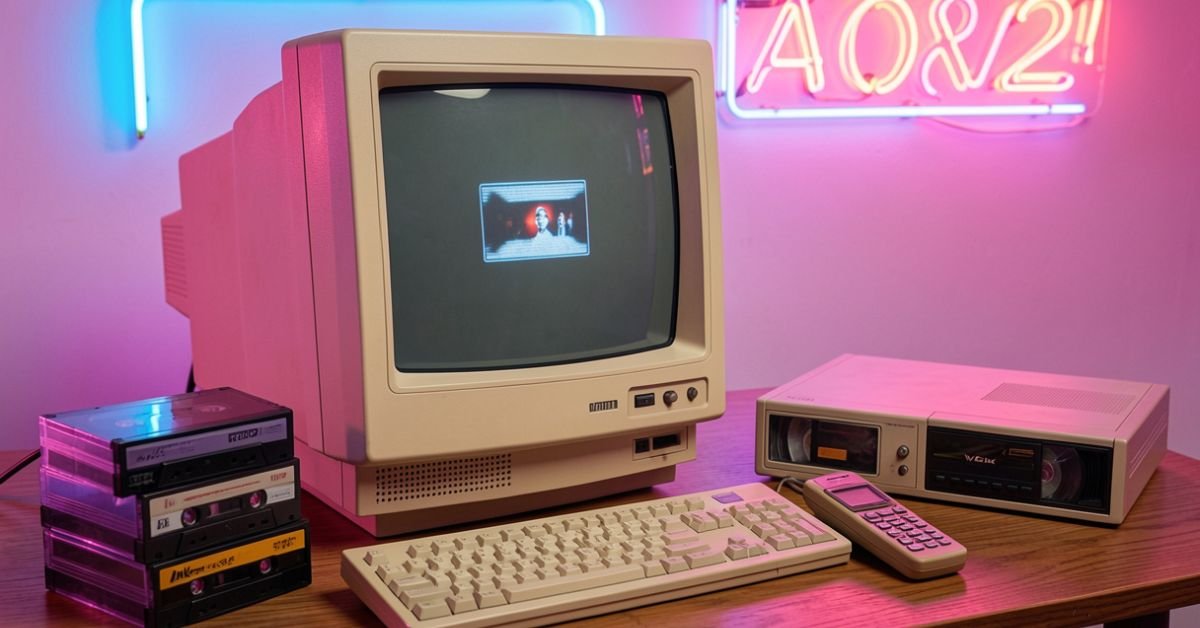
1980s Technology That Changed Our World Forever
Remember when installing software meant feeding floppy disks into your computer one by one? Or when making a mobile call required carrying a device the size of a brick?
The 1980s wasn’t just about big hair and neon colors. This decade fundamentally transformed how we work, communicate, and entertain ourselves. The innovations from this era laid the groundwork for smartphones, streaming services, and cloud computing.
1980s technology refers to the revolutionary electronic and digital innovations developed during the decade spanning 1980-1989, including personal computers, mobile phones, video game consoles, and digital media formats. These breakthroughs moved technology from specialized industrial use into everyday homes and businesses, creating the foundation for our modern digital lifestyle.
In this article, you’ll discover the major technological breakthroughs of the 1980s, understand their impact on society, and see how they evolved into the devices you use today.
Quick Summary
The 1980s brought personal computers into homes, introduced mobile communications, revolutionized entertainment through gaming consoles and VCDs, and established digital standards still used today. This decade transformed technology from industrial tools into consumer products, creating the digital age we now live in.
The Personal Computer Revolution
The early 1980s marked the moment computers stopped being room-sized machines for corporations and became household items.
IBM PC and the Business Standard
When IBM released its Personal Computer in 1981, it did something revolutionary. Instead of keeping everything proprietary, IBM used off-the-shelf parts and published technical specifications.
This decision changed everything. Other companies could now build compatible machines, creating the PC clone market. Within a few years, computers became affordable enough for small businesses and families.
The IBM PC ran on MS-DOS, Microsoft’s operating system that used text commands. You couldn’t click icons or drag files. Everything happened through typed instructions. Despite seeming primitive now, this system powered businesses throughout the decade.
Apple Macintosh and the Graphical Interface
In 1984, Apple introduced the Macintosh with a commercial that ran during the Super Bowl. The Mac brought something most people had never seen: a graphical user interface with icons, windows, and a mouse.
Suddenly, you didn’t need to memorize commands. You could point, click, and drag. This made computers accessible to people without technical training.
The Mac found its home in creative industries. Graphic designers, publishers, and artists embraced it. Desktop publishing was born, letting small companies produce professional-looking materials without expensive printing services.
Home Computing Goes Mainstream
While IBM and Apple targeted businesses and professionals, other companies brought computing to families.
The Commodore 64, released in 1982, became the best-selling single computer model of all time. It cost around $595 at launch, making it affordable for middle-class families. Kids learned programming in BASIC, played games, and discovered digital creativity.
The Commodore 64 had something special: impressive graphics and sound capabilities for its price range. This made it a gaming powerhouse, introducing millions to digital entertainment.
Communication Technology Breaks Free
The 1980s liberated communication from wires and cables.
The First Mobile Phones
Motorola’s DynaTAC 8000X, approved for commercial use in 1983, was the first portable cellular phone. It weighed two pounds, offered 30 minutes of talk time, and took 10 hours to recharge.
The price? Nearly $4,000, equivalent to about $10,000 today.
Despite the cost and size, mobile phones represented freedom. Business executives and wealthy professionals could make calls from their cars or while traveling. No more searching for payphones or missing important calls.
The cellular network infrastructure built during the 1980s created the foundation for today’s mobile internet. Those early investments in cell towers and transmission technology made smartphones possible.
Fax Machines Transform Business
Before email, businesses sent documents via fax machines. These devices scanned paper documents and transmitted them over phone lines to another fax machine anywhere in the world.
By the late 1980s, fax machines became standard office equipment. You could send contracts, diagrams, or handwritten notes instantly instead of waiting days for postal delivery.
The fax machine showed businesses the value of instant document transmission. This expectation of immediate communication paved the way for email adoption in the 1990s.
Entertainment Technology Enters the Home
The 1980s transformed how people experienced entertainment at home.
Video Game Consoles Create an Industry
The Nintendo Entertainment System (NES), released in North America in 1985, revitalized the video game industry after the market crash of 1983.
Nintendo succeeded by focusing on quality control. They required developers to get approval before releasing games, preventing the flood of low-quality titles that had crashed the market.
Games like Super Mario Bros., The Legend of Zelda, and Metroid became cultural phenomena. Kids traded tips at school, called Nintendo’s game counselor hotline for help, and spent hours mastering challenging levels.
The NES sold over 60 million units worldwide, proving that video games weren’t a passing fad but a legitimate entertainment medium.
VCRs Give Control to Viewers
Videocassette recorders changed the relationship between viewers and television networks.
For the first time, you could record shows and watch them later. You could fast-forward through commercials. You could rent movies and watch them at home instead of going to theaters.
The VHS format war between JVC and Sony’s Betamax ended with VHS dominating the market. Video rental stores appeared in every neighborhood. Blockbuster Video, founded in 1985, grew into a cultural institution.
This technology introduced the concept of on-demand entertainment. The ability to watch what you want, when you want it, started with VCRs and evolved into streaming services like Netflix.
Compact Discs Revolutionize Music
Sony and Philips introduced the Compact Disc in 1982, offering digital audio quality in a durable, compact format.
CDs didn’t scratch like vinyl records. They didn’t degrade like cassette tapes. You could skip directly to any track instead of fast-forwarding or rewinding.
The music industry embraced CDs, reissuing classic albums and promoting the superior sound quality. By the end of the decade, CD players became common in homes and cars.
The digital audio standard established by CDs led directly to MP3s, digital music players, and streaming services. The transition from analog to digital audio began with this shiny disc.
Software and Operating Systems
The applications running on computers became just as important as the hardware itself.
Spreadsheets Change Business
VisiCalc, introduced in 1979 for the Apple II, proved that personal computers had practical business value. But Lotus 1-2-3, released in 1983 for IBM PCs, became the killer app that drove computer adoption.
Lotus 1-2-3 combined spreadsheet functions with charting and database features. Accountants, financial analysts, and business managers could model scenarios, track budgets, and analyze data without manual calculations.
This single program justified the cost of buying a computer. Companies purchased IBM PCs specifically to run Lotus 1-2-3.
Microsoft Excel, released for Mac in 1985 and Windows in 1987, eventually overtook Lotus. But the spreadsheet concept itself revolutionized business planning and analysis.
Word Processing Replaces Typewriters
WordPerfect and Microsoft Word transformed document creation during the 1980s.
Word processors let you edit text before printing, check spelling automatically, and format documents with different fonts and styles. Corrections that once required retyping entire pages now took seconds.
Law firms, publishing companies, and corporate offices replaced typewriters and typing pools with computers and word processing software. This shift dramatically increased productivity and changed office workflows.
The Technology Behind the Scenes
Some innovations weren’t visible to consumers but enabled everything else.
The Microprocessor Gets Powerful
Intel’s processors evolved rapidly through the 1980s. The 8088 processor in the original IBM PC ran at 4.77 MHz. By 1989, the Intel 80486 reached 25 MHz and could execute complex instructions.
This increasing processing power made sophisticated software possible. Each generation of processors enabled better graphics, faster calculations, and more complex programs.
Storage Capacity Grows
Hard drives became standard in personal computers during the 1980s. Early models held 10 or 20 megabytes. By the end of the decade, 100-megabyte drives were common.
Floppy disks evolved too. The 5.25-inch floppies that held 360 kilobytes gave way to 3.5-inch disks storing 1.44 megabytes in a more durable plastic case.
These storage improvements let software become more sophisticated. Programs could include graphics, multiple features, and extensive data.
How 1980s Innovations Connect to Today
Every major technology category today traces back to 1980s foundations.
| 1980s Technology | Modern Evolution | Key Connection |
|---|---|---|
| IBM PC | Desktop and laptop computers | Established PC architecture standards |
| Mobile phones | Smartphones | Cellular network infrastructure |
| Nintendo NES | PlayStation, Xbox, Switch | Proved gaming as mainstream entertainment |
| VCRs | Streaming services | On-demand viewing concept |
| Compact Discs | Spotify, Apple Music | Digital audio standard |
| Lotus 1-2-3 | Excel, Google Sheets | Data analysis and modeling |
The graphical interfaces pioneered by Apple influenced every modern operating system. The cellular networks built for brick phones evolved into 4G and 5G. The gaming industry that Nintendo revitalized now generates more revenue than movies and music combined.
Understanding these connections helps explain why certain technologies succeeded while others failed. The innovations that solved real problems and created genuine value grew into today’s digital infrastructure.
The Cultural Impact of 1980s Tech
These technologies didn’t just change what people could do. They changed how people lived, worked, and thought about the future.
The Home Office Emerges
Personal computers and modems made working from home possible. While not widespread in the 1980s, the concept of the home office took root.
Freelancers, consultants, and entrepreneurs could run businesses from spare bedrooms. This planted seeds for today’s remote work culture.
Digital Literacy Becomes Essential
As computers entered schools and workplaces, basic digital skills became necessary rather than optional.
Schools introduced computer labs where students learned typing, programming basics, and how to use educational software. This generation grew up comfortable with technology in ways their parents weren’t.
The Beginning of Digital Culture
Online bulletin board systems (BBS) let computer owners connect via phone lines to share messages and files. These text-based communities were the earliest form of social networking.
While primitive compared to modern social media, BBS culture established the idea of online communities, digital identities, and information sharing that defines internet culture.
Why This Decade Still Matters
The 1980s created the template for how technology enters everyday life.
Before this decade, advanced technology stayed in corporate offices, universities, and government facilities. The 1980s made technology personal, portable, and consumer-friendly.
This shift in thinking matters more than any specific device. Companies learned to design for ordinary people, not just engineers. Technology became something that should be intuitive and useful rather than complicated and specialized.
The entrepreneurial energy of the 1980s tech scene, particularly in Silicon Valley, established the startup culture that still drives innovation. Garage startups became billion-dollar companies. Teenagers became industry leaders. Taking risks on new ideas became respected rather than reckless.
Exploring More Technology History
The evolution of technology from the 1980s to today reveals patterns worth understanding. Learning about vintage computing and retro technology helps you appreciate how far we’ve come and predict where we’re heading.
The gaming industry’s journey from simple pixels to photorealistic graphics shows what happens when passionate creators meet improving technology. The history of personal computing demonstrates how solving specific problems creates unexpected opportunities.
These stories aren’t just nostalgia. They’re roadmaps showing how innovation actually happens—usually messier, slower, and more interesting than you’d expect.
Keep Exploring the Digital Past
The innovations from the 1980s created the foundation for everything we consider modern technology. Understanding this decade helps you see today’s tech landscape more clearly.
As new technologies emerge—artificial intelligence, quantum computing, augmented reality—the lessons from the 1980s remain relevant. Real innovation solves real problems. User-friendly design beats technical sophistication. Open standards accelerate progress faster than closed systems.
At BlogNex, we connect technology’s past to its present and future. Explore our other articles on technology history and digital innovation to discover how yesterday’s breakthroughs shape tomorrow’s possibilities.
Conclusion
The 1980s gave us personal computers, mobile phones, gaming consoles, and digital media that changed everything. These innovations moved technology from specialized labs into everyday homes and offices.
Today’s smartphones, streaming services, and cloud computing all trace back to this revolutionary decade. Understanding 1980s technology helps us appreciate how far we’ve come and where we’re heading next.
The lesson remains clear: technology that solves real problems and focuses on users always wins.
Frequently Asked Questions
What was the most important technology invented in the 1980s?
The personal computer, especially the IBM PC and Apple Macintosh, had the biggest impact. These machines brought computing into homes and businesses, creating the foundation for today’s digital world.
How much did computers cost in the 1980s?
The IBM PC cost $1,565 in 1981 (about $5,000 today), while the Apple Macintosh was $2,495 in 1984. The affordable Commodore 64 sold for $595, making it accessible to families.
Were 1980s computers connected to the internet?
No, the modern internet didn’t exist for consumers. People used bulletin board systems (BBS) via dial-up modems. The World Wide Web wasn’t invented until 1989 and became public in the early 1990s.
What games were popular in the 1980s?
Pac-Man (1980) dominated arcades, while Super Mario Bros. (1985), The Legend of Zelda (1986), and Tetris (1984) became iconic home gaming titles that shaped the industry.
How did people store data before hard drives were common?
Floppy disks were the main storage method, holding limited data. Cassette tapes offered cheaper storage for home computers. Hard drives were expensive and only became standard in PCs by the late 1980s.
What replaced technology from the 1980s?
VCRs became DVDs, then streaming. Floppy disks turned into CDs, USB drives, and cloud storage. Brick phones evolved into smartphones. Most transitions took years as digital technology improved.